Do You Need Planning Permission for Commercial Solar Panels?
Many commercial solar installations in England can proceed without a full planning application, thanks to Permitted Development Rights (PDR) set out in the Town and Country Planning (General Permitted Development) (England) Order 2015 (the GPDO). Whether your project qualifies depends on the type of installation, the building itself, and its location.
The GPDO defines three classes of permitted development relevant to commercial solar: roof or wall-mounted systems (Class J), standalone ground-mounted arrays (Class K), and solar canopies over car parks (Class OA). Each has specific conditions that must be met. If your installation falls outside these conditions, you will need to apply for planning permission through your local planning authority.
Roof-Mounted Solar on Commercial Buildings (Class J)
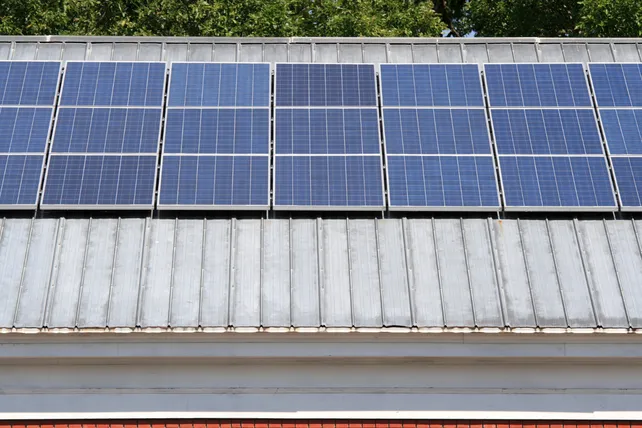
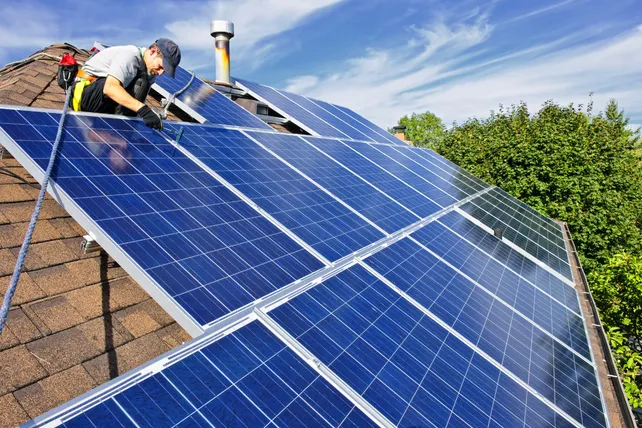
Under Class J of Part 14 of the GPDO, installing solar PV on the roof or walls of a non-domestic building is permitted development, provided several conditions are met:
- Projection limits: Equipment on a pitched roof must not protrude more than 200mm beyond the plane of the roof slope. Wall-mounted equipment has the same 200mm limit.
- Flat roof height: On a flat roof, the highest part of the solar equipment must not exceed 1 metre above the highest part of the roof (excluding any plant or equipment already on the roof).
- Edge distance: Roof-mounted equipment must be set back at least 1 metre from the external edge of the roof.
- Prior approval: Roof-mounted solar PV (Class J(c)) requires prior approval from the local planning authority, covering design, appearance, and any potential glare impact on neighbours.
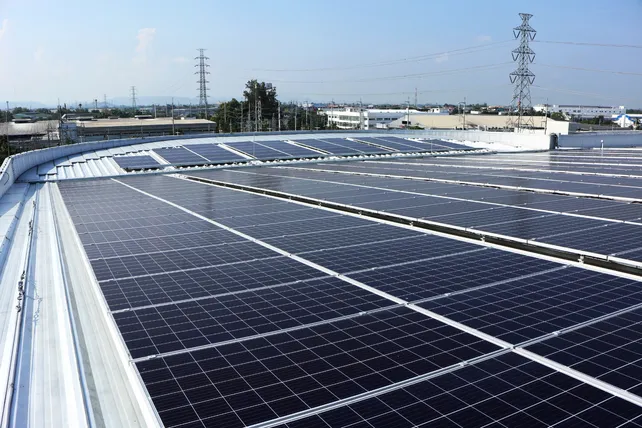
Importantly, Class J has no upper limit on the area of roof that can be covered with solar panels, provided these dimensional conditions are met. This makes it practical for large warehouse and industrial roof installations.
Class J does not apply to listed buildings, buildings within the curtilage of a listed building, or scheduled monuments. Wall-mounted systems on article 2(3) land (including conservation areas) that face a highway are also excluded.
Standalone Solar on Commercial Land (Class K)
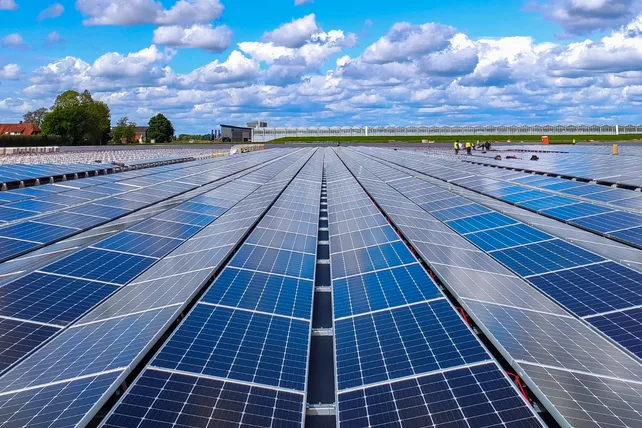
Class K covers standalone (ground-mounted) solar within the curtilage of a non-domestic building. This is more restrictive than roof-mounted installations:
- Height: Maximum 4 metres, reduced to 2 metres on article 2(3) land (conservation areas, AONBs, National Parks) near a highway.
- Boundary setback: Must be at least 5 metres from the boundary of the curtilage.
- Panel size: The total surface area of panels must not exceed 9 square metres, and no dimension of the array may exceed 3 metres.
- One unit only: Only one standalone solar installation is permitted per curtilage.
The 9 square metre limit means Class K is suited to small demonstration or supplementary installations rather than large ground-mounted arrays. Any commercial ground-mounted solar project beyond these limits will require a full planning application.
Solar Canopies Over Car Parks (Class OA)
A newer addition to the GPDO, Class OA permits solar canopies over non-domestic off-street parking areas. Key conditions include:
- Maximum height of 4 metres above ground level
- Must be at least 10 metres from the curtilage of any dwelling or block of flats
- Surface water runoff must be directed to permeable or porous surfaces
- The installation must be completed within 3 years
- Prior approval is required, covering siting, design, appearance, and glare
Solar car park canopies are increasingly popular for commercial sites with large parking areas, such as retail parks, distribution centres, and office campuses. They generate electricity without using roof or ground space, while also providing covered parking.
Listed Buildings and Conservation Areas
Listed buildings are excluded from all classes of permitted development for solar equipment. Any solar installation on a listed building (Grade I, II*, or II) requires both planning permission and Listed Building Consent. The same applies to buildings within the curtilage of a listed building.
The test for Listed Building Consent focuses on the impact on the building's special architectural or historic interest. Under the National Planning Policy Framework (NPPF), paragraph 205 requires that "great weight should be given to the asset's conservation," regardless of the level of harm. Applications are more likely to succeed where panels are positioned on less prominent elevations, where fixings are reversible, and where a heritage impact assessment demonstrates minimal harm to significance.
In conservation areas, roof-mounted solar is still permitted development under Class J, but wall-mounted systems facing a highway are excluded. Standalone solar under Class K has reduced height limits near highways. Local authorities can also issue Article 4 Directions that remove permitted development rights entirely in specific areas, requiring planning permission for all solar installations regardless of size.
When Full Planning Permission Is Required
You will need to apply for planning permission if your project:
- Involves a listed building or scheduled monument
- Exceeds the dimensional limits for permitted development (projection, height, edge distance)
- Is a ground-mounted array exceeding 9 square metres or 3 metres in any dimension
- Is in an area covered by an Article 4 Direction removing solar PDR
- Does not meet prior approval requirements under Class J(c) or Class OA
The NPPF provides support for renewable energy applications. Paragraph 168 states that local planning authorities should not require applicants to demonstrate overall need for renewable energy and should "give significant weight to the benefits associated with renewable and low carbon energy generation." This positive policy framework means well-prepared applications for commercial solar are generally viewed favourably.
Pre-application advice from your local planning authority, while typically charged as a service, is worth pursuing for larger or more complex installations. It can identify potential issues early and significantly reduce the risk of refusal.
Practical Steps for Your Installation
Before commissioning a commercial solar installation, take these steps:
- Check your building's status: Confirm whether it is listed, in a conservation area, or subject to any Article 4 Directions. Your local planning authority's online planning portal will show this.
- Assess against PDR conditions: For roof-mounted systems, check the 200mm projection, 1 metre flat-roof height, and 1 metre edge setback limits. If your installation meets all conditions, you may still need prior approval under Class J(c).
- Engage a qualified installer: Experienced commercial solar installers can advise on whether your project qualifies as permitted development and navigate planning requirements on your behalf. For systems up to 50kW, using an MCS-certified installer is also required if you want to access the Smart Export Guarantee for any surplus electricity exported to the grid. For larger systems, MCS certification is not required.
- Submit prior approval if required: Even where planning permission is not needed, prior approval under Class J(c) or Class OA requires a formal application to your local authority covering design, appearance, and glare impact.
- Keep records: Document your PDR assessment. If you proceed without a planning application, having a clear record of how your installation meets the GPDO conditions protects you against future enforcement queries.
See also: Our commercial solar cost overview pulls together pricing tables, tax relief, grants, sector breakdowns and FAQs in one place.

References
- Legislation.gov.uk — The Town and Country Planning (General Permitted Development) (England) Order 2015, Schedule 2, Part 14
- Gov.UK — Planning Practice Guidance: Renewable and Low Carbon Energy
- Gov.UK — National Planning Policy Framework, Chapter 14: Meeting the Challenge of Climate Change
- Gov.UK — Planning Practice Guidance: Conserving and Enhancing the Historic Environment
- Planning Portal — Solar Panels: Planning Permission
- MCS — Solar Photovoltaic (PV) Systems
- Ofgem — Smart Export Guarantee (SEG)