Flat roof solar panels for commercial buildings
Flat roofs are the most common roof type for commercial and industrial buildings in the UK. They are also ideally suited to solar panel installation, with several advantages over pitched roofs.
Ballast-mounted systems
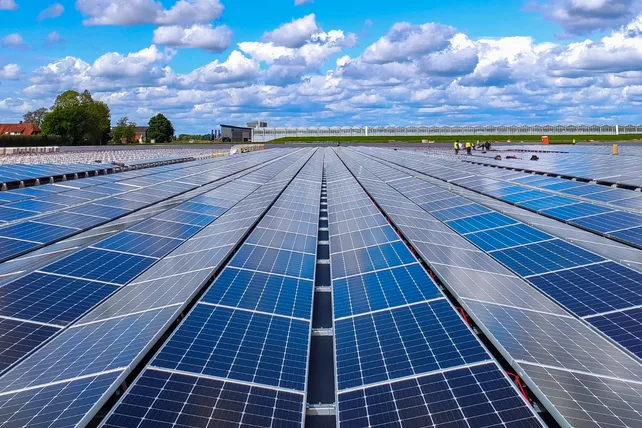
The most popular method for flat roof commercial solar is ballast mounting. Panels are secured to angled frames weighted down with concrete blocks or ballast trays. This approach requires no roof penetration, preserving the waterproof membrane and avoiding potential leaks.
Ballast systems are quick to install and can be repositioned or removed without damage. They are suitable for most flat roof types including felt, single-ply membrane, asphalt and concrete.
Tilt angle and orientation
Flat roof systems allow panels to be installed at the optimum tilt angle (typically 10–15 degrees for UK commercial systems) facing due south. This maximises annual generation. Panels on pitched roofs are constrained by the existing roof angle and orientation.
East-west configurations are increasingly popular on flat roofs. Panels face alternating east and west, producing a flatter generation curve throughout the day. This can improve self-consumption for businesses operating across full daylight hours.
Structural considerations
The combined weight of panels, frames and ballast is typically 15–25 kg/m². Most commercial flat roofs are designed to support loads of 60+ kg/m², so structural reinforcement is rarely needed. Your installer will carry out a structural assessment as part of the site survey.
Older roofs with unknown structural capacity, or those showing signs of wear, may need a structural engineer's report. If the roof membrane is reaching end-of-life, it is often worth re-roofing before installing solar to avoid disruption later.
Typical system sizes
A flat roof can accommodate approximately 5–7 kWp per 100m² of usable roof area (accounting for spacing between rows to avoid self-shading). A 1,000m² warehouse roof might accommodate a 50–70 kWp system, generating enough electricity to power the equivalent of 15–20 typical homes.
Get flat roof solar quotes
nu.energy connects you with MCS-accredited installers experienced in flat roof commercial solar. Get up to 3 competitive quotes, free and with no obligation.